
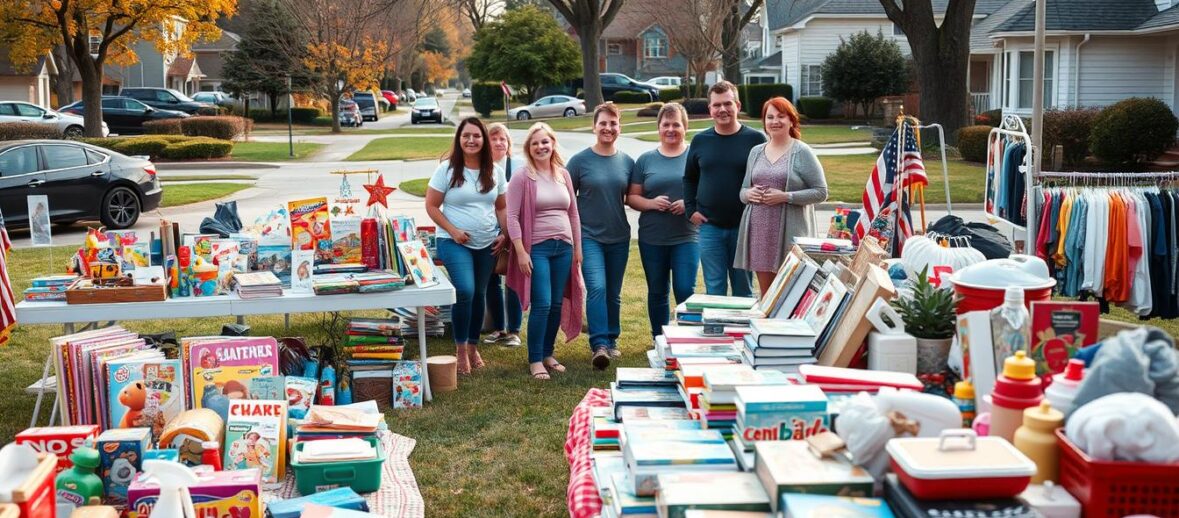
Your closets are full of things you don’t use. Your garage is too small for your car. Your basement is packed with old stuff. This clutter can turn into cash.
Many people are scared to host a garage sale. But, those who do find it’s a great way to clean up and make money. One family made $1,549 in two days. Another made $737 in six hours.
Hosting a garage sale does two things at once. It frees up space in your home. It also gives you extra money for things you want. You don’t need special skills to do it.
This guide will help you host a garage sale. You’ll learn about permits, pricing, and how to display items. You’ll also learn how to manage customers and make your sale a success.
Key Takeaways
- Garage sales can generate hundreds or even thousands of dollars when planned properly
- Decluttering your home and earning money happen at the same time
- Successful yard sale preparation involves permits, pricing, advertising, and organization
- Attracting customers to yard sales requires smart signage and clear layouts
- Multiple payment options make buying easier for your customers
- End-of-day discounts help you sell remaining inventory quickly
- Leftover items can be sold online or donated after your event
Planning and Preparing for Your Garage Sale
Starting a garage sale needs careful planning. You must know local laws, choose the best time, and gather a team. These steps help avoid problems and increase your earnings. Let’s look at what you need to do before the sale.
Checking Local Permits and HOA Regulations
First, find out what your city or county requires. Many places need permits for garage sales. You can find this info on your city’s website or by calling city hall. Remember, fines can hurt your profits.
If you live in a neighborhood with HOA rules, you must follow them. Homeowners associations might limit sales or where you can put signs. Some areas only allow two sales a year, each lasting two days. Check your HOA rules early to avoid trouble.
- Visit your city or county government website
- Call city hall for permit requirements
- Review your HOA rules and restrictions
- Get permits at least two weeks before your sale
- Ask about sign placement rules
Choosing the Best Date and Time
The timing of your garage sale is crucial. The best days are Friday or Saturday mornings. People are paid and ready to shop. The first weekend of each month is ideal because shoppers have money.
If you’re moving, plan your sale three to four weeks before. This allows time to donate items. Check the weather and plan around bad weather. Morning hours from 7 a.m. to noon are best. You might have a half-day sale to avoid heat or rain.
- Pick the first weekend of the month
- Choose Friday or Saturday morning
- Schedule three to four weeks before moving
- Check the weather forecast ahead of time
- Plan hours between 7 a.m. and noon
Gathering Your Crew and Partnering with Neighbors
You can’t do it alone. Get family and friends to help with setup and sales. Teamwork makes the work easier and more fun.
Team up with neighbors for a bigger sale. More families mean more items and shoppers. This attracts more buyers. Talk to neighbors and check community boards to find other sales. This makes your sale a destination for shoppers.
- Ask family members to help
- Invite close friends to join your team
- Talk to neighbors about a multi-family sale
- Coordinate dates to avoid conflicts
- Check community boards for local sales
- Plan rotation for breaks and meals
Good planning leads to successful sales. Knowing local rules, choosing the right time, and having a team sets you up for success.
Decluttering Your Home and Gathering Inventory
Starting a garage sale means first clearing out your home. Begin by tackling one room at a time. Make a list of all your belongings, including furniture, clothes, and electronics. This helps you see what you have before sorting.
When you gather items, ask yourself a few questions:
- How often do I use this?
- Do I actually need this?
- Would I be better off selling it?
- Have I touched this in the past year?
Organize items into three piles: keep, sell, and donate or trash. Set aside items you’re ready to sell. Be honest with yourself about letting go of things you’ve forgotten.
Sort one room at a time to avoid feeling overwhelmed. For big downsizing jobs, consider renting a storage unit. It gives you space to organize without cluttering your home.
This sorting process is crucial for success. Spending a few weeks on it makes the sale day smoother. Remember, selling items means you won’t have to move or store them anymore. More items mean more profit for your garage sale.
How to Have a Successful Garage or Yard Sale: Pricing Strategies That Work
Getting your pricing right is key to a successful garage sale. You want to sell items fast and make good money. Set fair prices to attract buyers without losing out.
Start pricing as you sort items. This saves time and keeps you organized. Your goal is to declutter, and any extra money is a bonus.
Don’t let sentimental value affect your pricing. That CD collection might mean a lot to you, but buyers see it differently.
Setting Fair Prices for Different Item Categories
Use the 10-30-50 rule for pricing. Price items in fair condition at 10% of retail. Good quality items should be 30% of retail. Brand-new items can be up to 50% of retail.
Here are specific pricing examples for common items:
- Baby clothes (gently-used): $1-3
- Adult clothes (with tags): $5 and up
- Adult clothes (used): $3-5
- Shoes: $3-7
- Coats: $5-15
- Hardcover books: $1-2
- Paperback books: $0.25-0.50
- DVDs and CDs: $3-5
- Toys and games: $1-3
- Home décor items: $3-5
- Kitchen gadgets: $1-3
- Small appliances: No more than one-third of retail price
- Power tools: $10-50
- Low-quality furniture: $10-50
- High-quality furniture: One-third to one-half of retail price
When unsure, check eBay or Facebook Marketplace for prices. This helps you understand what buyers pay.
Using Color-Coded Stickers and Bundling Items
Color-coded stickers make pricing easy. Assign each color a price. For example, green is $1, blue is $5, and red is $10. Display a chart at checkout to show prices.
Bundling small items helps sell more. Instead of $5 each, sell four DVDs for $10. Bundle 10 romance novels for $2 instead of $0.25 each. This saves time and offers a deal.
Price in 25-cent increments. This makes change easy on busy sale day. Round prices like $3.50 instead of $3.73 for simple math.
Price slightly higher than your minimum to allow for haggling. This strategy is flexible and balances making money with selling items quickly.
Organizing and Displaying Your Items Effectively
Running a garage sale is like running a retail store. Your goal is to make the buyer’s experience pleasant and simple. The way you set up your space directly affects how many items you sell and how much money you make. Think of your garage sale layout as a roadmap that guides shoppers through your sale with ease. When customers feel comfortable and can find what they want, they buy more.
Start by thinking about how professional stores arrange their merchandise. They use tables, shelves, and organized displays. Your garage sale layout should follow the same approach. The goal is organizing a garage sale so that items sit at eye level rather than forcing people to bend down and dig through boxes on the ground.
Creating an Attractive and Easy-to-Navigate Layout
Display your items on tables and shelves whenever possible. When you run out of surfaces, use large boxes or bookcases for displaying garage sale items. Group similar items together in logical areas. Keep all kitchenware in one spot, toys in another section, and books together. This helps shoppers find what interests them without wandering aimlessly.
Place your most eye-catching variety up front. Mix antique tools, holiday decorations, and baby gear together near the entrance. This attracts different types of customers and draws them into your sale. Leave plenty of open space around high-traffic areas like clothing racks and book tables where people linger and browse. Crowded displays discourage shopping.
Strategic placement matters when merchandising yard sale items. Put items that appeal to many people at the front. Save niche items for deeper into your sale space. This layout keeps customers moving and exploring.
Cleaning and Presenting Items for Maximum Appeal
Clean items sell better and command higher prices. Here’s what to do before your sale:
- Dust off older items thoroughly
- Wash and fold all clothing neatly
- Hang clothes on racks instead of folding them in piles
- Display clothing as complete outfits when possible
- Place a mirror near clothing and accessories
- Fill bicycle tires and basketballs with air
- Scrape mud off sports equipment
- Add fresh batteries to items that need them
- Test electronics with an extension cord nearby
These small touches make your merchandise look attractive and appealing. When buyers can test items and see them displayed nicely, they feel confident about their purchases. This confidence leads to more sales and higher profits for your garage sale.
Creating Eye-Catching Signs and Advertising
To get people to your garage sale, start with smart ads and eye-catching signs. Signs are your strongest marketing tool. They catch eyes on the streets near your home. Unlike paid ads, signs do a lot of the work.
Your garage sale signs need three key qualities:
- Highly visible with bright colors and bold, large text
- Placed everywhere—at every intersection in your area
- Simple with only the essential information
You don’t need a lot of money for professional signs. Use hot pink or bright yellow paper. Mount them on foam core board from Dollar Tree for about one dollar. Seal the edges with packing tape for weather protection. Your total cost? Less than one dollar per sign.
To promote your sale well, cover your neighborhood with signs. Use at least twelve large signs (20 inches by 30 inches) on main roads. Place forty or more small signs (15 inches by 20 inches) on side streets. Put at least two signs at every intersection within a three-block radius. Always include directional arrows pointing toward your home.
Hang signs using staple guns on wooden poles, packing tape on metal street signs, or stakes hammered into the ground. Set them up one hour before your sale starts, or the night before to reduce morning stress. Always take your signs down after the sale ends. Being a good neighbor matters.
Don’t forget online advertising for promoting a garage sale beyond your neighborhood:
- Post on Craigslist several days before and the morning of your sale
- List on Facebook Marketplace and local neighborhood groups
- Use Yard Sale Search and Garage Sale Finder websites
- Check community message boards and local classifieds
When advertising a yard sale online, include photos of valuable items, your full address, specific times, and accepted payment methods. Highlight special finds like kids’ toys, tools, or collectibles. Post early in the morning—around 5 a.m. on sale days—to reach serious shoppers.
“Good signage is the difference between a busy yard sale and an empty driveway.”
Keep your marketing consistent across all signs and ads. Use the same colors, fonts, and layout everywhere. This branding approach makes your sale easy to remember and simple to find throughout your community.
Accepting Multiple Payment Methods
Today’s garage sale shoppers want to pay in different ways. Many don’t carry cash anymore. So, offering various payment options can really help your sales.
When you accept different payments, you make it easier for people to buy. Studies show that shoppers who can use cards spend more. They might spend three to ten times what they planned.
Imagine a customer comes with only $10 cash. They see a lamp for $25. Without card options, they leave without buying. But with cards, they buy the lamp and more, spending $75 extra.
Setting Up Digital Payment Options
Digital payments for yard sales are simple. You don’t need expensive gear or a hard setup. Here are some easy tips to get started:
- Square – Offers a free card reader. You pay 2.75% per transaction, usually less than $10 for a whole sale
- PayPal – Free app that works with your smartphone for instant payments
- Cash App – Simple and quick for accepting payments from customers
- Venmo – Popular among younger buyers who prefer peer-to-peer transfers
Advertise that you accept cards on all your signs and online listings. Many won’t stop unless they see this message. Make sure your mobile hotspot works well, especially if your home Wi-Fi is weak.
Keeping Cash and Change on Hand
Don’t forget about cash. Visit your bank before the sale to get lots of small bills. Start with more change than you think you’ll need. Missing change can hurt your sales a lot.
For multi-day sales, restock your cash each morning. This prevents shortages that can cost you business.
Managing Your Garage Sale Day
Running a garage sale is more than just setting up tables. It’s about preparation and having the right team. Success comes from good planning and smart decisions early in the morning.
You need at least two people to run your sale well. One should handle the cash box or card reader. The other should help shoppers, answer questions, and provide backup. This keeps things organized and manages customers smoothly.
Wake up early on your sale day. Serious shoppers arrive at dawn, sometimes before you open. Have everything ready and priced before opening. Hanging signs the morning of takes 90 minutes, so do it the night before.
Stock your checkout area with supplies for smooth transactions:
- Plastic or paper grocery bags for purchases
- Newspaper for wrapping fragile items
- Water and snacks for yourself and helpers
- Enough cash for making change
Make your property inviting. Mow your lawn, sweep your porch, and trim bushes and trees. A clean yard makes everyone feel welcome. Create a large sandwich board or banner to grab attention.
Stay energized throughout the day. Keep drinks and snacks nearby to stay alert and friendly. Your positive attitude and helpful service make the experience pleasant for all.
Negotiating and Handling Customers
Customers at garage sales love to haggle. It’s part of the fun and tradition of yard sale shopping. When you’re ready for haggling at yard sales, you need a game plan. Knowing how to handle these conversations can help you sell more items while protecting your profits. The key is staying friendly and confident in your pricing items for garage sales.
Before your sale starts, decide on your minimum prices. Think about what you’re willing to accept for each item. This “rock bottom” price helps you negotiate without feeling pushed around. If someone offers less than you’re comfortable with, you can politely decline or make a counteroffer.
Haggling Tips and Setting Price Limits
The best time to be flexible is not at the start of your sale. Early in the day, you’ll have plenty of shoppers coming through. Save your negotiating garage sale prices strategy for the afternoon when foot traffic slows down. By then, you’ll know which items are moving and which ones are sitting.
- Set firm minimum prices before the sale begins
- Stay patient during peak hours—don’t accept every offer
- Read your customers; some genuinely can’t afford full price
- Politely decline offers that are too low
- Remember that steady traffic means you can be selective
Your primary goal is clearing out your home, not making maximum profit. If someone walks away without buying, another customer will arrive soon. This takes the pressure off accepting bad deals.
Offering End-of-Day Discounts
As your sale winds down, it’s time to get aggressive with pricing items for garage sales. Grab a thick permanent marker and physically slash prices on your tags. When shoppers see the crossed-out price, they feel like they’re getting an amazing deal.
- With 2-3 hours left, reduce prices by 25-50%
- In the final hour, mark items at rock-bottom prices
- Bundle items together—a box of books for $1, bags of clothing for $5
- Consider giving items away to families who need them
- The goal is clearing inventory, not holding inventory
Remember, those unsold items would be donated anyway. Any money you make through garage sale discounts is a bonus. You’re saving yourself the work of hauling everything to a donation center.
Selling Leftover Items Online
Your garage sale is just the start to making more money. Some items can find a new home online. After your sale, you can sell to people who missed it. Learning to sell online can turn leftovers into cash.
Not every item does well at a garage sale. Small, valuable items often get lost in the crowd. Consider selling these items online instead.
Strategic pricing matters when selling online. A book worth $1 at your sale might sell for $8 online. Designer clothes sell fast on Poshmark or ThredUP. Video games and classic electronics attract collectors.
Here are some platforms for different items:
- eBay and Craigslist for collectibles and general merchandise
- Poshmark and ThredUP for adult clothing and accessories
- Kidizen for children’s clothes and baby items
- Facebook Marketplace for furniture and local pickups
- Specialized children’s resale shops for quality baby gear
Good garage sale tips include taking photos before the sale ends. List items early to build interest. Quality photos and honest descriptions help sell items faster.
One seller made an extra $378 selling online before their garage sale. Another sold baby equipment for $45 at a resale shop. Your leftover items can be a big profit when sold online.
Donating or Disposing of Unsold Items
Your garage sale is over, and now it’s time to deal with what didn’t sell. This is your last chance to declutter your space. Remember, nothing comes back in the house. Bringing unsold items back home means they’ll just clutter up again.
Plan how you’ll handle leftover items before your sale starts. This way, you won’t have to make tough decisions when you’re tired.
- Pack valuable items like gently-used baby gear or name-brand clothing directly into your car and take them to resale shops or consignment stores the same day
- Mark down remaining items to extreme prices ($1 per box of books, $5 per box of DVDs) during the final hours to move them quickly
- Box up everything else and drive directly to Goodwill or Salvation Army without bringing items back inside your home
- Leave a “free” box near your sidewalk if you live in a busy neighborhood—items disappear fast
- Schedule a charity pickup for the day after your sale if you lack truck access
Items that are too worn or broken should be thrown away. It’s okay to let them go. They’ve done their job.
“If you were willing to sell something for $1, it clearly doesn’t have an important place in your life anymore.”
Donating unsold items to local charities helps your community. It also completes your decluttering project. This final step turns your garage sale into a life-changing event.
Conclusion
You now have all the garage sale tips you need to run a successful garage sale. This guide covers planning, pricing, marketing, and managing customers. By preparing well, you can make a lot of money.
Real people have made $737 in six hours, $1,549 in ten hours, and $1,972 with online sales. You can do the same by following these steps.
Getting ready for a garage sale takes a lot of work. You’ll sort items, price them, arrange displays, make signs, and handle customers. But the rewards are worth it.
You’ll have less clutter, more money, and extra space. If you’re moving, it’s even easier. Donating leftover items helps others in your community.
Hosting your first garage sale might seem daunting. But with the right preparation, it will go smoothly. Even if you don’t plan another sale soon, consider one every few years.
A garage sale every few years helps declutter and earn extra money. You have all the knowledge and tools you need. It’s time to make your own successful garage sale story.